

Today I wanted to share one of my best client cases.
In 1 year, (excluding brand), we did x4 on non-brand transactional traffic, 2,500 AI impressions/day, and +90% in attributed purchases.
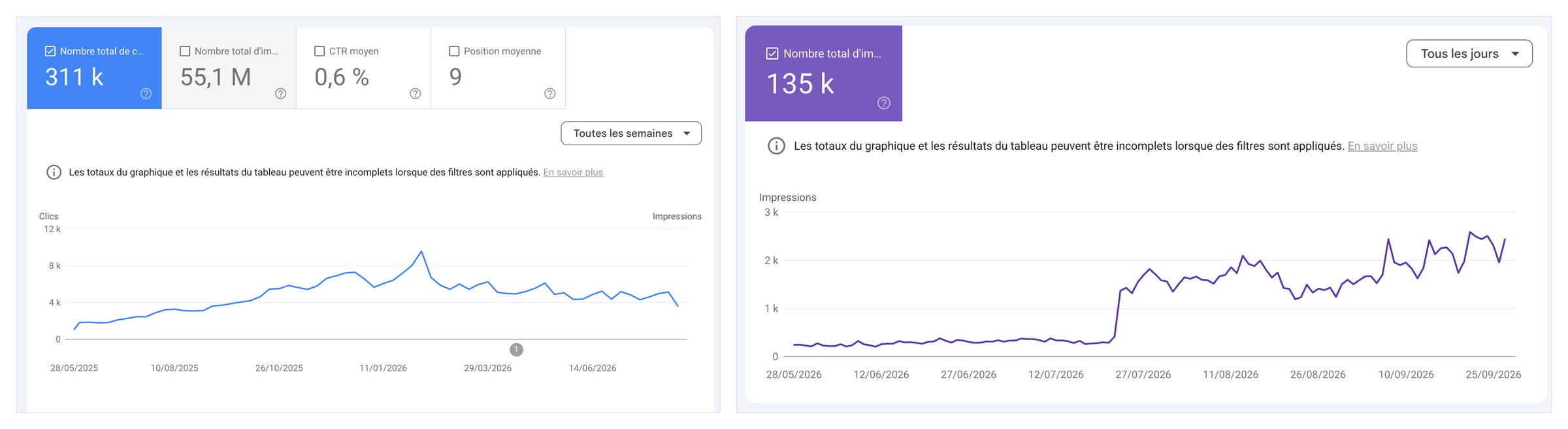
To get these results in a highly competitive market, we did programmatic SEO.
See this edition as a practical guide to do this. I’ll share the method we use for Staycation, to be very actionable for you.
At the end you will know how to:
Find the right topics for your site
Apply the 4 golden rules to create good content
Build a template that ranks and converts
Produce the pages and measure them
Let’s go.
But first, what is programmatic SEO?
Programmatic SEO means creating hundreds, even thousands, of pages from one page template, to target long-tail queries.
It gets even more interesting now with AI.
Before, we swapped a few small dynamic variables in a page.
Now we can create pages with the same template but with completely different content, more personalized.
For me, the real difference with programmatic is the automation that comes with it.
For example, Staycation already had 10 city pages targeting long-tail keywords “hotel spa + city”. But they had to create new templates by hand. It took them about half a day per page. The foundations were there.
After we worked on it, we managed to create 300 pages, with much more content that matched the search intent, powered by one database and an AI content pipeline.
1. Find your topics
There are several ways to do it. The first is to ask yourself how you can make good use of your data.
Every programmatic play is one search pattern, repeated:
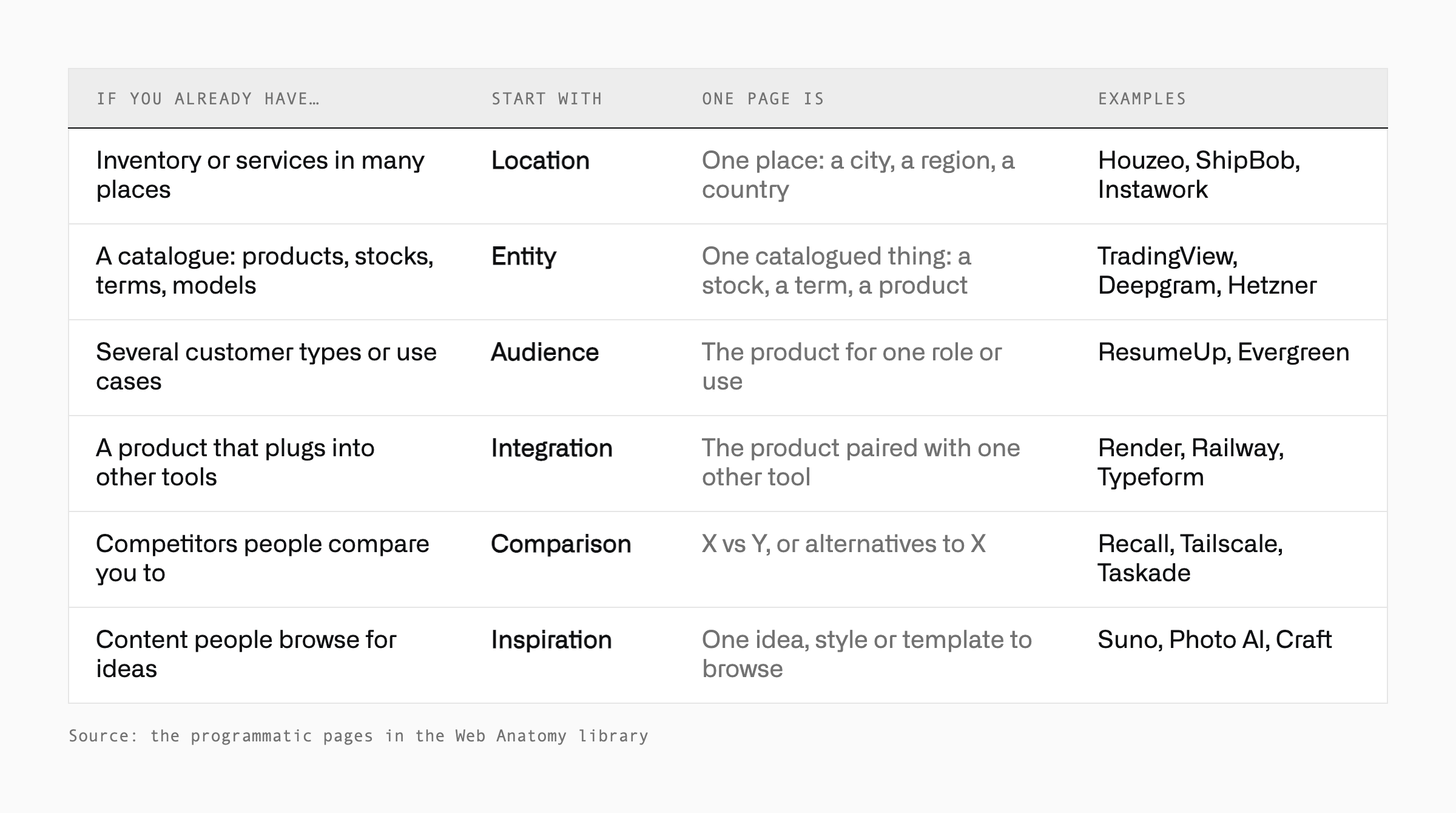
Staycation had proprietary data on hotels (descriptions, prices, reviews…) across many locations, so that’s the pattern we decided to go all in on. But you can do it for any other pattern.
Why programmatic SEO is powerful
Programmatic SEO works when one intent repeats across many variations: a city, a tool, an integration, a job title.
Most of the time, the head term is a bloodbath and nearly impossible to rank for. At Staycation, “hotel spa” meant fighting Booking, Tripadvisor and every OTA on earth.
However, the variations around it can be won. “Hotel spa Annecy”, “hotel spa Marseille” and 300 other cities in France have less volume, but also fewer competitors.
The good thing with programmatic SEO is that the day you expand your offer (pool, jacuzzi, sea view), the page inventory multiplies again without rebuilding the system around it. That’s what we did at Staycation: we started with the spa, then added the pool, sea view and jacuzzi.
But before creating a single page, we followed four rules.
2. Four rules before you generate anything
Rule 1: Don’t care about volume
Most teams take their SEO tool, sort by volume, and fight for the 5 biggest variations (the 5 big cities, the 5 best-known tools) where the competition is maximal.
That’s exactly what I don’t recommend.
Instead, we focus where the volume is very low. Variations at 10 searches a month. Even under 10.
Here is why:
1. The volume in keyword tools isn’t real. It’s an estimate, and new searches can take months to show up.
2. Being first on a small keyword already pays. If a keyword gets fewer than 10 searches a month and you rank first, you get most of those clicks. Across 300 pages, that adds up.
3. If a SEO tool shows no volume, your competitors will be too lazy to build a page for it.
So how do you find these keywords?
Trust your own inventory. Start from what you have: every city where you have hotels, every product in your catalogue, every tool you integrate with.
Each one is a page candidate, whatever volume the SEO tool shows.
At Staycation, the list of pages came from the hotel database, not from Semrush. 300 winnable pages for smaller cities.
Small volume + small volume + small volume = a lot of traffic.
Rule 2: The supply floor
Demand is a thing but you also need supply.
So the question to ask is: do I have enough inventory (products, listings, providers, integrations) to make a real page for this variation?
At Staycation: do we have enough spa hotels in this city?
A page with 2 hotels is a weak page, Google won’t pay attention to it, and it drags the whole silo down.
Focus on quality rather than quantity.
So we set a floor.
Below 3 bookable hotels in a city, no page.
This will keep quality.
Define your minimum inventory per page (products, listings, providers, integrations, whatever your unit is) and refuse to generate below it.
Rule 3: Put your SEO silo in categories
Before you generate anything, sort the pages of your silo into categories. At Staycation, there were three: cities, departments and regions.
You don’t treat a city page like a region or a department page. The intent is different, so the categories decide two things:
1. The template. Each category gets its own version of the template. A city page is for booking a hotel there. A region page is for exploring an area, so it shows more places and more context.
2. The internal linking. The categories tell you which pages link to which. Cities link to the other cities nearby, regions to their departments.
The same logic works for any pattern. For an integrations silo, the categories could be tools, then tool categories (CRM, email, analytics).
Rule 4: Bring what your competitors don’t
Try to bring a “unique” angle when you’re answering a keyword.
For us, for example, “hotel spa Bordeaux”, we think about what we could bring that our competitors couldn’t really do.
We added more geographic criteria. For example, that one spa hotel is five minutes from the center of Bordeaux.
We gave advice based on what the person feels like. If you’re in a couple mood, we recommend this hotel. If it’s winter and a bit gloomy, another one.
Try to play rather than list an inventory: go after the sub-intents, the things people hope to find and don’t find on your competitors’ pages.
Key takeaways
Rule 1, volume: don’t sort by search volume. Build pages for variations at 10 searches a month or less. Together, they bring more traffic than the head term you can’t rank for.
Rule 2, supply: set a minimum inventory per page (3 hotels at Staycation) and don’t create a page below it.
Rule 3, categories: organize pages in levels (city, department, region) and use those levels for your internal links.
Rule 4, the expert angle: on each page, add something your competitors don’t have: distance to the center, a mood, a season.
3. Build a template that ranks and converts
The blocks below work for any programmatic page. The screenshots show them on Staycation’s spa pages.
Before
When I joined, Staycation already had localized pages: the classic pSEO template you’ve seen a thousand times.
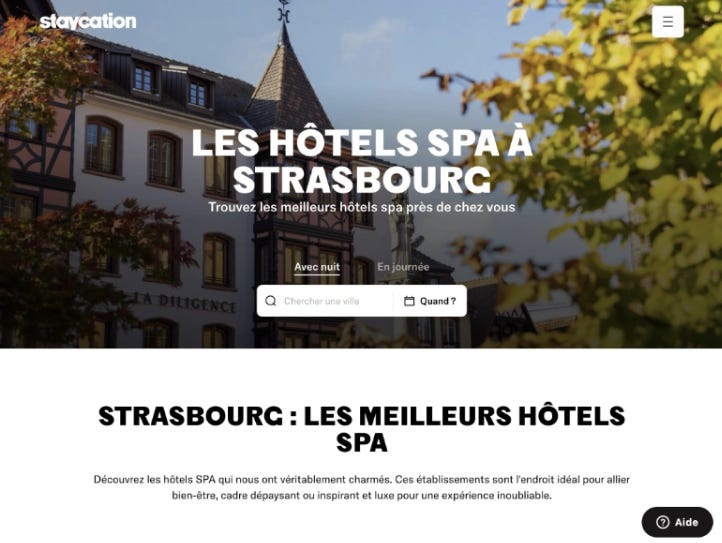
A hero, a title, a list of hotels, a short generic text block. Only the city name changed from one page to the next.
Hero
1. Hero: repeat the query the visitor typed.
At Staycation: “Les hôtels spa à Strasbourg”, one line of real positioning, and the search bar already set to “Autour de Strasbourg”.
Above it, the breadcrumb (France → Grand Est → Bas-Rhin → Strasbourg),
and a “Mis à jour le” date to show recency
At the very top, one line of borrowed authority from the whole platform: “4,8/5 · +1M téléchargements”.
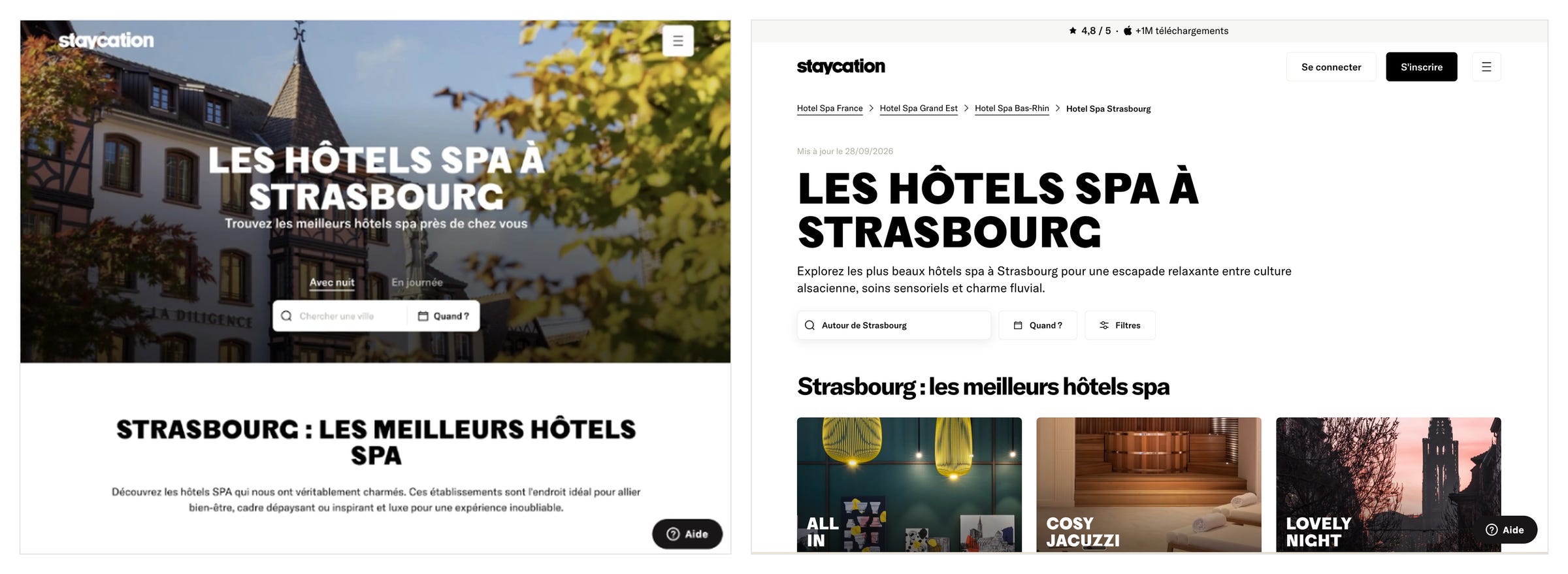
Before (left) and after (right): the Strasbourg hero
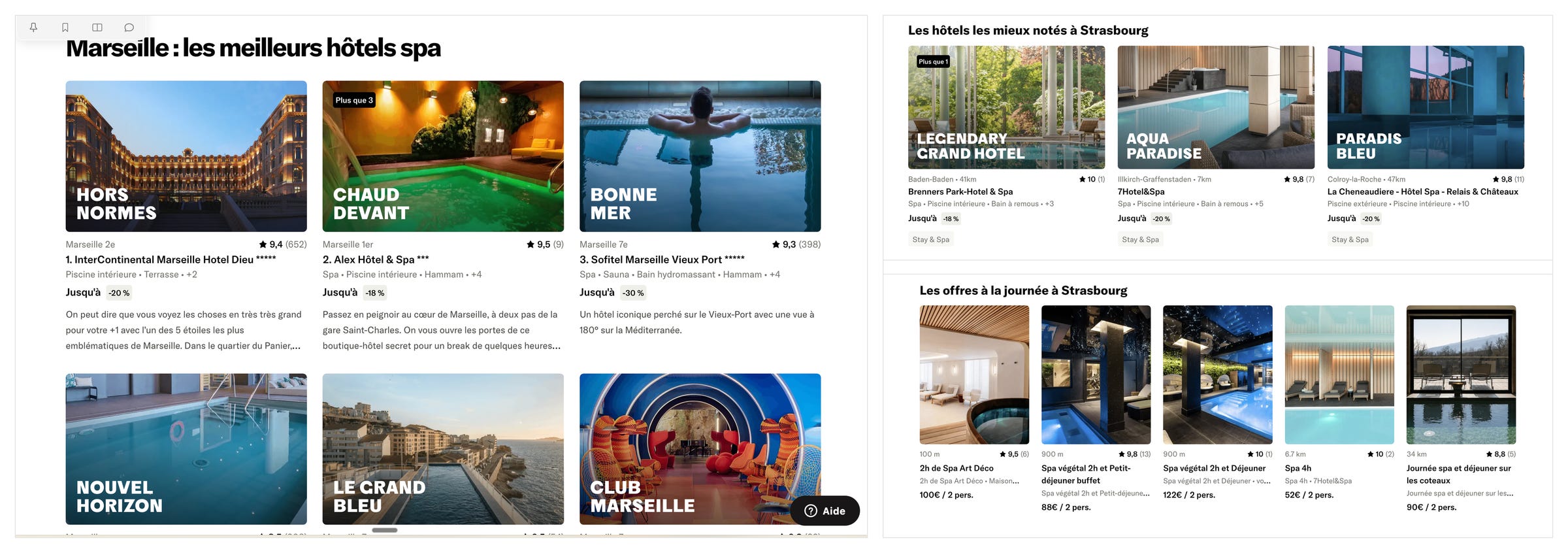
2. Listing: the inventory is the moat.
Your products, listings or tools, shown for this city (not generic).
Provide info only you can give. At Staycation: numbered hotel cards with neighborhood, rating and review count, the spa amenities (hammam, sauna, indoor pool), the current discount.
Real prices go with it, because our SEO analysis showed that people were interested in them. So we added an average price, minimum and maximum for each page.
Every heading here targets a secondary SEO keyword: “best spa hotel”, “most ranked hotel spa”, “day spa hotel”
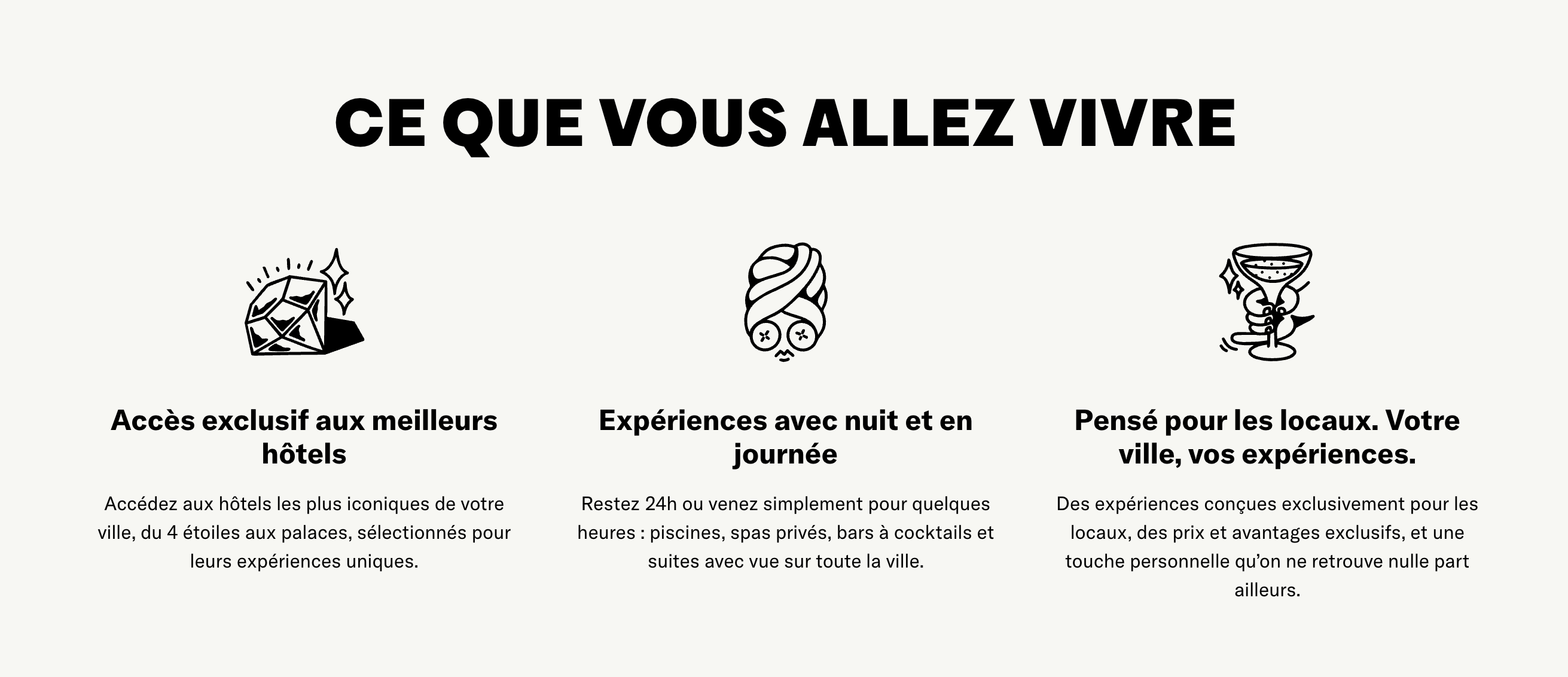
3. Why choose you.
pSEO is about getting more leads or revenue from your pages. Not just getting traffic to it.
Most pSEO templates skip this block. The visitor landed from Google and may never have heard of you, so they don’t know why they should buy from you rather than from the biggest player in the results.
The more you’re clear on what are your strengths, and what makes your solution and variation page unique, the better your conversion will be.
It also helps with LLMs, when users need more guidance to see the value of one service over another.
Ce que vous allez vivre
4. Internal linking: the more contextual the better
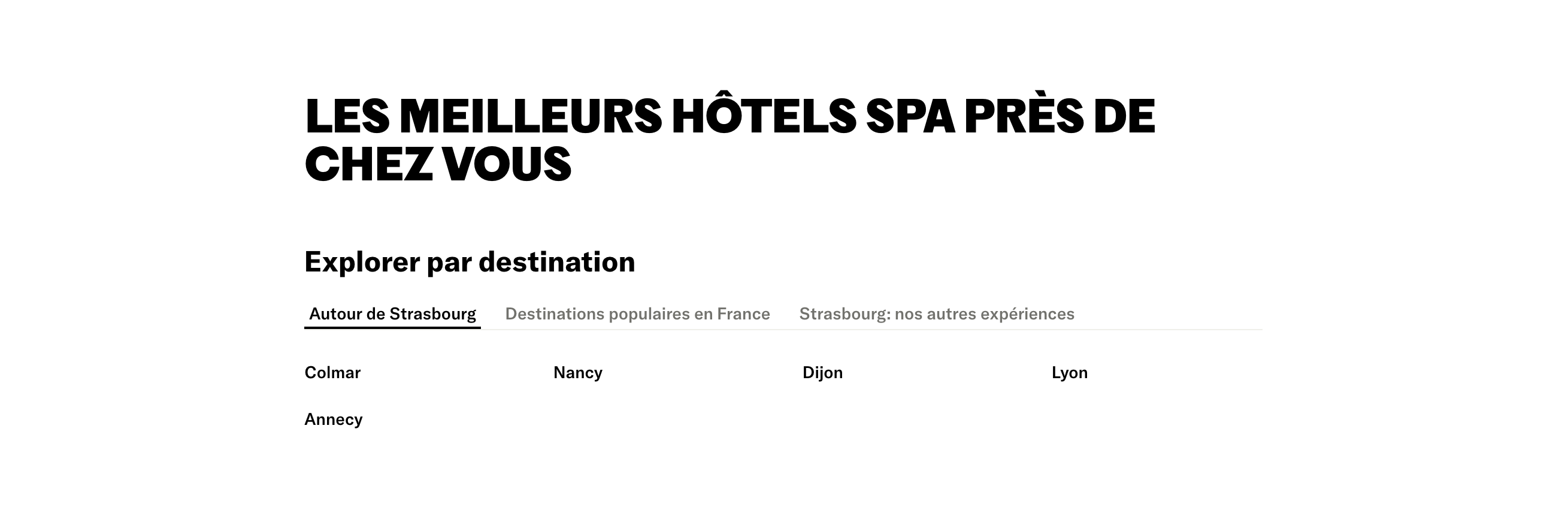
At Staycation, 3 tabs:
“Autour de Strasbourg” (the nearest cities, computed geographically),
“Destinations populaires en France” (popular cities), the ones with the highest competition,
“Strasbourg : nos autres expériences” (bridge to the other silos).
All three lists were generated deterministically with a script. Nothing was generated with AI or by hand, which can lead to mistakes.
internal linking tabs
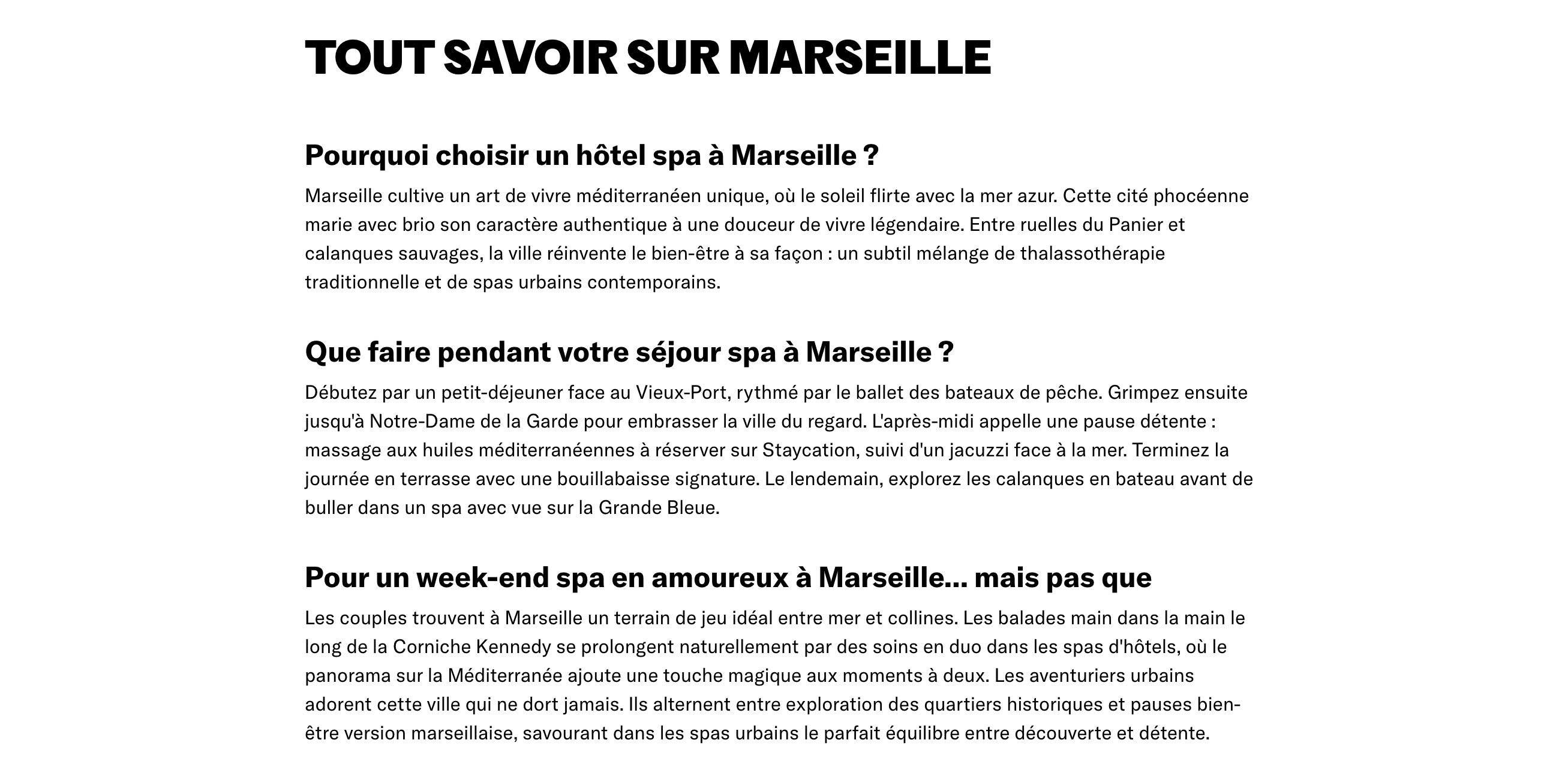
5. Editorial: where the page earns depth.
For each variation page, we have an editorial section with text visible by default.
In it, we show why the city is unique (why choose a spa hotel here, what to do during your stay, a weekend for couples).
This is AI-written but data-fed, and it’s what separates a page from a database dump.
Marseille editorial
6. FAQ: the keyword maxing
We have around 9 questions per variation.
For each page, a script selects 9 questions, checks the user intent and matches it with the database in order of priority. So we prioritize a question about sea view for a location near the coast, or bike rental in the middle of France.
Each question is a micro-keyword the page now covers, and each answer names real hotels, linked, and their pricing.
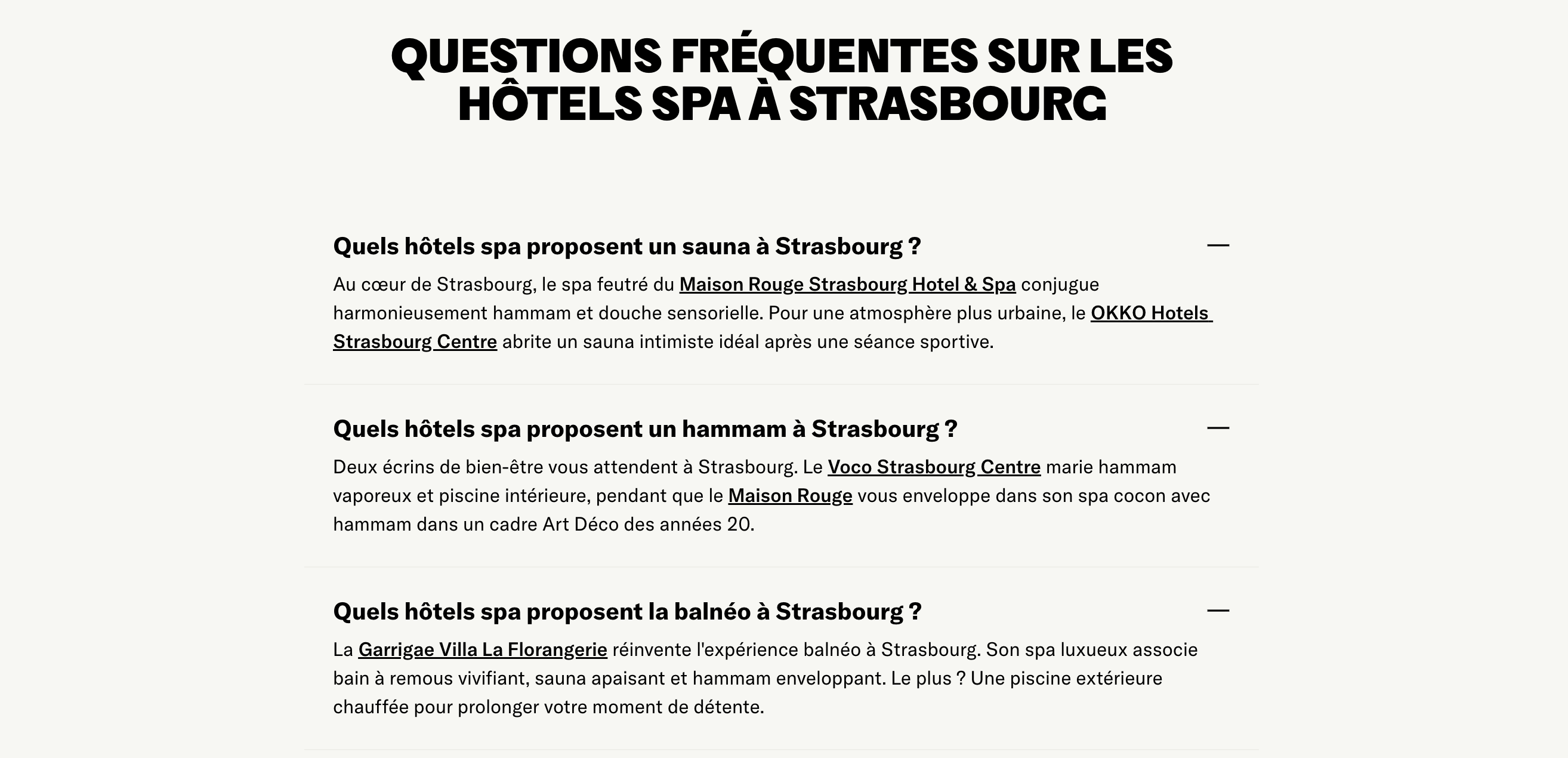
Strasbourg FAQ
7. The hub page
The URL staycation.co/fr/hotel-spa-france/strasbourg sits under the hub staycation.co/fr/hotel-spa-france.
The goal of the hub is to target the head keyword. We knew it would be difficult to rank for, so we mostly use it to distribute traffic, as you can see here with the internal linking module that expands to show all the child pages per category.

8. The technical layer
Last but not least, add the structured data for the FAQ and the breadcrumb.
Everything needs to be rendered server side (SSR), so Google sees it and it loads faster (we had to fix it).
4. Produce the pages and measure them
The strategy I’m sharing here is the same as my content machine strategy (How to publish one page a day without publishing slop). So if you haven’t read it, I strongly recommend it, because that’s where I go into real detail.
Long story short, I have two elements that let me create the content:
The data, meaning the proprietary data I’ll use. Here it was Staycation’s data, with all the info on prices, distances, rankings and ratings. I don’t change that. The idea is to refresh it from time to time.
On top, the prompt: section by section, we iterate on the prompts with the collected data until we’re satisfied.
One page equals one row in Supabase (my Database), with all the info I need on the page. Then, for each section of the page, I had a specific with the logic I needed.
At the time, I built the logic on n8n, with different automations to fetch the data from Supabase, process it, run the prompts, and then send it straight to their CMS.
Today I’d rather do it in Claude Code, because the models have improved enormously. (Which CMS, and whether you need one at all: see CMS, headless CMS or nothing?)
You won’t get the best prompts on the first try. You’ll inevitably get things the model hallucinated.
So here is what I did:
Create at least 1 variation per use case (one page with a lot of supply, one thin)
Create at least 1 variation per sub-category
Check for hallucinations. On my side, I removed the AI’s access to outside research, so it relies only on the database info.
Compare the pages with the competitors’ to see if they target the right keywords and intent
The more you iterate on the first batch, the better the results will be when you generate the 300.
After launch: measure like a pSEO, not like a blog
Programmatic pages have their own funnel, and it starts before traffic:
Indexation rate: of the pages you published, how many did Google actually index? This is the first verdict on quality. If it’s low, Google is telling you which pages are weak: so add more content, be patient, and strengthen internal linking.
Impressions: indexed pages entering the game. Watch which level performs (cities vs departments vs regions).
Clicks: last, not first. On sub-10-volume pages, clicks arrive months after indexation, and in aggregate.
Web Anatomy updates
If you’re looking for programmatic SEO pages, I’ve added 22 of them to the Web Anatomy library this week, along with 40 other page types, including webinar, login and AI pages.
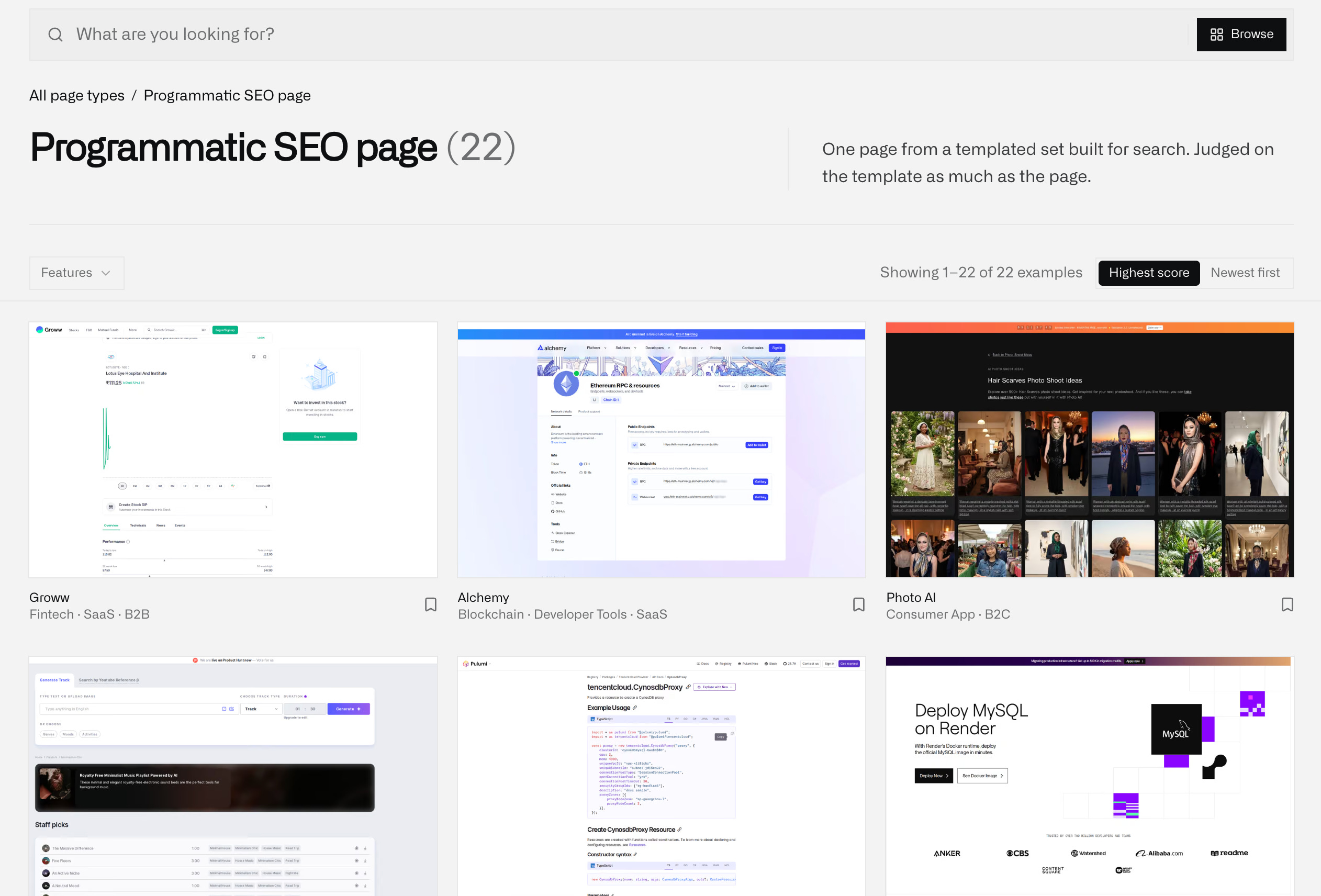
Pick your pattern, then write your own rules: your long-tail entry point, your supply floor number, your hierarchy. Then audit one of your existing template pages against the blocks above.
Personal note
This is all for this week.
And if someone forwarded you this email, you can subscribe here.
See you next week,
Gabriel